
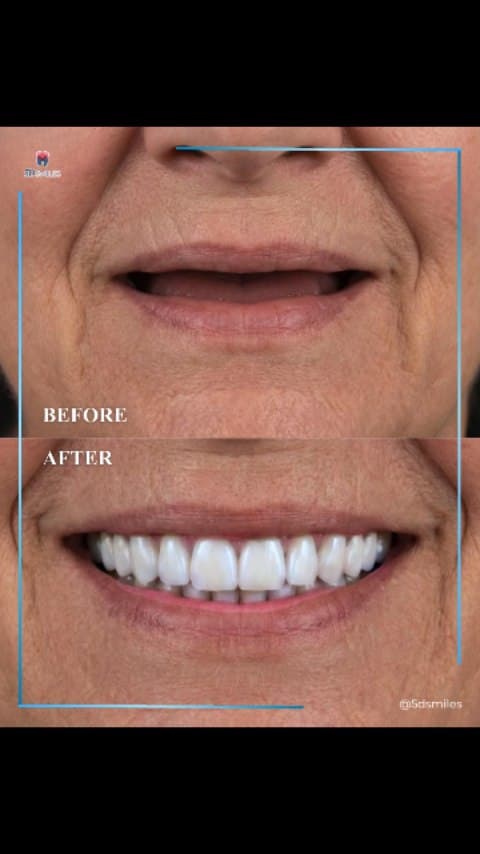
Case File · Front Tooth Implant · Downey, CA
A Front Tooth Implant, Before and After: the #8 Case
Real patient, published with written consent. Individual results vary.
The Short Version
A single front tooth, the #8 central incisor you see in the photo above, is the hardest implant in dentistry to make look real, because it has to match a tooth your eye already knows by heart. This is a real case from my Downey practice, shared with the patient's consent: one implant, a same-day temporary so they were never seen without a front tooth, and a final crown shaded and shaped to disappear next to the natural teeth. Here is exactly how a front-tooth before and after like this gets made, and who I would send toward a different option instead.
The full how-and-why lives on the Front Tooth Implant page. This is one real case.
The Tooth
Why a single front tooth is the hardest one I place
The photo above is a number eight, the central incisor, dead center of the smile. Replacing a back molar is mostly about function: it has to chew and stay put. A front tooth has to do something harder. It has to fool an eye that already memorized the tooth next to it, the exact shade, the way light passes through the edge, the little point of gum between the teeth. Get the function right and miss the look by a hair, and the patient sees it every morning in the mirror.
That is the whole challenge of the aesthetic zone, and it is why I treat a front tooth completely differently from a back one. The bone on the lip side of a front tooth is thin, the gumline is on display, and there is no hiding a compromise. The deeper mechanics of all of this live on my front tooth implant page; this case is what it looks like in practice.
The Plan
Never without a front tooth, and a gumline built to match
Two things decide whether a front-tooth case looks real, and I plan both before I ever pick up an instrument. The first is that nobody walks around with a gap in their smile, not for a day. When the timing allows it I place the implant and a same-day temporary crown in one visit, so the patient leaves with a tooth in the space, not a hole. That temporary does quiet, important work: it shapes the gum while everything heals so the final crown emerges from the tissue the way a real tooth does.
The second is the foundation. After a front tooth is lost the thin bone on the lip side tends to collapse inward, which is the difference between a crown that looks full and one that looks sunken, so I rebuild that contour with grafting when the site needs it. A 3D CBCT scan tells me exactly how much bone is there before I commit to anything. None of this is guesswork; it is measured.
The Procedure
How the before becomes the after
On surgery day the failing tooth comes out as gently as I can manage, because every wall of bone I preserve is bone I do not have to rebuild. I place a single titanium implant into solid bone behind the socket, graft the gap on the lip side to hold the contour, and fit the temporary crown shaped to support the gum. Then we wait, and the waiting is the part patients underestimate. The implant needs a few months to fuse to the bone, and the gum needs that time to settle into its final shape.
When it has integrated, I take the final impression and build a monolithic zirconia crown, and this is where the case is won or lost. I match the shade, the translucency at the edge, and the contour to the teeth on either side, and I would rather send a case back to the lab twice than deliver a crown that is a shade off. The result is the after you see above: one tooth, indistinguishable from its neighbors.
The Honest Part
When I would not do this
An implant is usually the best answer for a missing front tooth, but not always, and I will tell you when you are the exception. If you are a teenager or in your early twenties, your jaw may still be growing, and an implant is fixed in place while your natural teeth keep migrating, so a few years later it can sit too high. For a still-growing patient I will often recommend a bonded bridge to hold the space until growth finishes, and then we place the implant. That is not me turning down the case. It is me protecting the result, which is the only thing worth protecting.
The same honesty applies to the look. If the bone and gum cannot be rebuilt to perfectly match, I will tell you that before we start instead of after, so you can decide with the real picture in front of you.
“On a front tooth, the goal is not a good implant. The goal is that nobody, including you, can tell which one it is.”
Dr. Henry Qiu, DDS · UCLA-trained · 2,000+ implants placed
The Case, in Numbers
#8
central incisor, the aesthetic zone
1 visit
to a same-day temporary tooth
from $3,500
single titanium implant
shade-matched
monolithic zirconia final crown
One titanium implant, a same-day temporary to shape the gum, lip-side grafting to hold the contour, and a final zirconia crown matched to the natural teeth. A single titanium implant starts at $3,500 and a metal-free zirconia implant from $9,500; the aesthetic grafting a front tooth sometimes needs can add to that, and you get your exact number in writing after a scan. Front teeth are lost-bone-sensitive: a systematic review of post-extraction ridge changes found major dimensional change in the first year, with the labial (lip-side) wall resorbing the most, which is exactly why an immediate temporary and grafting matter so much in the smile zone, and why the ADA treats implants as a well-established tooth-replacement option.
Questions about this kind of case
Does a front tooth implant really look natural?
It can, and that is the whole job. The result in this case is a single crown you cannot pick out from the natural teeth. What makes it look real is matching the shade, the translucency at the biting edge, and the gumline, plus a temporary that shapes the gum during healing. A front tooth implant that looks fake is almost always a gumline or shade that was not built to match, not the implant itself.
How long does a front tooth implant take from start to finish?
Plan on a few months. The implant is placed and, when the timing allows, a same-day temporary crown goes in so you are never without a front tooth. The implant then needs roughly three to six months to fuse to the bone and the gum to settle, and only then do I deliver the final shade-matched crown. I would rather take the time and get the match right than rush a front tooth.
Will I have a gap in my smile while it heals?
No, that is something I plan around from the start. When the case allows it I place a same-day temporary crown the day the implant goes in, so you leave with a tooth in the space. That temporary also does real work, shaping the gum so the final crown emerges naturally.
How much does a front tooth implant cost?
A single titanium implant starts at $3,500 and a metal-free zirconia implant from $9,500. A front tooth sometimes needs gum or bone grafting to rebuild the contour for a natural look, which can add to it. Rather than quote a number for a tooth I have not seen, I give you the exact price in writing after a 3D scan.
Is a front tooth implant better than a bridge?
Usually, because an implant replaces the root and does not touch the healthy teeth next door, while a traditional bridge grinds them down. The honest exception is a still-growing jaw in a teen or young adult, where I will often recommend a bonded bridge first to hold the space until growth finishes, then place the implant. It depends on your case, and I will tell you which one fits.
What if my front tooth has been missing for years?
It is still very doable, but the bone on the lip side will have shrunk over those years, so the case usually needs grafting to rebuild the contour before the crown can look full instead of sunken. A 3D scan shows exactly how much bone is there, and the plan is built from that.
Want a result like this?
Book your consult with Dr. Qiu.
Forty-five minutes with the surgeon, a 3D CBCT scan, an itemized plan, and exact pricing in writing. Serving Downey and all of Los Angeles County.
Book Your ConsultationOr call (562) 923-4538
This case is shared with the patient's written consent. Individual results vary with case complexity, medical history, and post-operative care; this is one real outcome, not a guarantee of yours.
References
- Bone healing and soft tissue contour changes following single-tooth extraction: a clinical and radiographic 12-month prospective study.. PubMed (NIH).
- Current Knowledge on the Healing of the Extraction Socket: A Narrative Review.. PubMed Central (NIH).
- Implants. American Dental Association (MouthHealthy).
Written by Dr. Henry Qiu, DDS. Sources are peer-reviewed studies and recognized health authorities.